

Here's an uncomfortable question: if a potential customer searched for what you do right now, would they find you, or your competitor?
For most small business owners, the honest answer is "I'm not sure." And that uncertainty is expensive. The overwhelming majority of consumers research a business online before ever making a purchase or picking up the phone, and nearly all local buying journeys now start with a search. If your business doesn't show up in that moment, you don't lose the sale to a better product or a lower price. You lose it to a business that was simply easier to find.
The good news? Online visibility isn't reserved for companies with big budgets. It's built through a series of practical, consistent moves, most of which you can start this week. Here are nine that matter most in 2026.
1. Make Sure Your Website Is Actually Working for You
Having a website isn't the finish line. Having one that performs is. A surprising number of small business sites share the same handful of problems: they load slowly, they're clunky on phones, and they don't tell visitors what to do next.
Each of those issues quietly costs you customers. More than half of all web traffic now comes from mobile devices, and visitors abandon slow pages within seconds. Meanwhile, studies consistently find that the majority of small business homepages lack a clear call to action, meaning even the visitors who do arrive aren't told how to take the next step.
Start with three questions:
Does it load fast? Run your site through Google's free PageSpeed Insights tool. If it takes more than three seconds on mobile, that's a priority fix.
Does it work on a phone? Pull up your site on your own phone. Can you read it without pinching and zooming? Can you tap the phone number to call? Is the contact form usable with a thumb?
Is the next step obvious? Every key page should have one clear call to action: "Request a Quote," "Book a Consultation," "Call Now." If a stranger landed on your homepage, would they know what to do within five seconds?
2. Treat Your Google Business Profile Like a Second Homepage
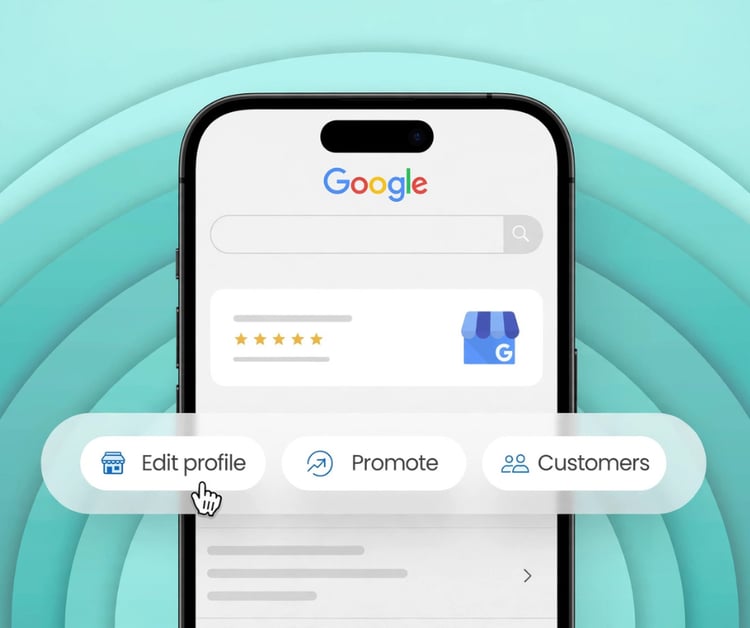
If you only have thirty minutes this week to spend on visibility, spend it here. Your Google Business Profile is free, it powers your presence on Google Maps and local search results, and increasingly, it feeds the AI-generated answers Google shows at the top of the page.
A complete, active profile gives Google structured, trustworthy facts about your business: what you do, where you are, when you're open, and what customers think of you. An abandoned one does the opposite.
Make sure yours includes:
- Accurate business name, address, phone number, and hours (including holiday hours)
- The right primary and secondary categories for what you actually do
- Recent, real photos of your work, your team, and your location
- Answers to the questions customers commonly ask
- Regular posts or updates, even brief ones
Businesses that keep their profiles current consistently outperform those that set them up once and walk away.
3. Build a Review Engine, Not Just a Review Page
Reviews aren't a vanity metric. They're a visibility engine. The vast majority of consumers read reviews before choosing a local business, most trust them nearly as much as personal recommendations, and research has repeatedly linked higher ratings to measurable revenue growth.
Reviews also do double duty in 2026: AI-powered search tools lean heavily on review signals when deciding which businesses to recommend. A steady stream of genuine, detailed reviews tells both humans and algorithms that you're credible.
The key word is engine: a repeatable process, not an occasional ask:
- Request a review at the moment of highest satisfaction (right after a successful job, delivery, or appointment)
- Make it effortless with a direct link or QR code
- Respond to every review, positive and negative. Responses build trust with the people reading them, not just the person who wrote them
- Never buy or fake reviews; platforms and AI systems are getting very good at detecting them, and the penalty isn't worth it
4. Structure Your Content to Be the Answer
Search has fundamentally changed. A growing share of Google searches now end without a click, because AI Overviews and answer engines like ChatGPT and Perplexity summarize the answer right on the page. That's the shift behind answer engine optimization (AEO): instead of just ranking for keywords, your content needs to be structured so AI systems can extract, trust, and cite it.
Here's what that looks like in practice:
Use question-based headings. Write headings the way your customers actually ask questions: "How much does a kitchen remodel cost in Houston?" rather than "Kitchen Remodel Pricing."
Answer immediately. Put a clear, direct answer in the first two or three sentences below each question heading, then elaborate. AI systems favor content that leads with the answer instead of burying it.
Add an FAQ section to key pages. FAQ content maps perfectly to how people query both search engines and AI assistants. (You'll see this in action at the bottom of this very article.)
Use schema markup. Structured data, like FAQPage, LocalBusiness, and Service schema, translates your content into a format machines can parse without guessing. It's one of the highest-leverage technical moves for AEO.
One important caveat: AEO doesn't replace SEO. Research shows a strong correlation between pages that rank in traditional search results and pages cited in AI Overviews. Traditional SEO gets you in the room; AEO structure gets you quoted.
5. Go Deep on Local, Not Broad on Everything
Nearly half of all Google searches have local intent, and a large majority of people who search for a local business on their phone visit or call within a day. For most small businesses, that means the fastest visibility wins are local ones.
Practical moves:
- Create a dedicated page for each location or primary service area, with unique content, not the same page with a swapped city name
- Include your name, address, and phone number (NAP) consistently on your site and everywhere else it appears online
- Write content that answers hyper-local questions: neighborhood guides, local pricing norms, region-specific advice
- Get listed accurately in the directories that matter for your industry
Consistency is the underrated part. Conflicting information across platforms, an old address on Yelp, a wrong phone number in a directory, erodes the confidence both search engines and AI systems have in your business data.
6. Publish Content That Answers Real Customer Questions
Content marketing doesn't mean churning out generic blog posts. The content that builds visibility in 2026 answers the specific questions your customers already ask you, on the phone, in emails, during consultations.
Keep a running list of every question a customer or prospect asks. Each one is a content opportunity, because if one person asked it, hundreds are searching it. A plumber answering "why does my water heater make a popping sound?" or an accountant explaining "what receipts do I actually need to keep?" is doing more for visibility than ten posts of generic industry commentary.
This approach also gives you a natural edge in AI search: original expertise, real examples, and first-hand experience are exactly what AI systems can't generate on their own, which makes them more likely to cite the businesses that provide them.
7. Show Up Where AI Looks for Trust Signals
AI answer engines don't just read your website. They read what the internet says about you. Research on AI citation patterns shows that platforms like Reddit, YouTube, and established review sites are among the most heavily referenced sources when AI tools recommend businesses.
You don't need to be everywhere. Pick the platforms where your customers genuinely spend time and where trust is built in your industry:
- Claim and maintain profiles on the review platforms relevant to your field
- Contribute genuinely helpful answers in communities where your customers ask questions
- Consider simple video content. Even basic "how to choose" or walkthrough videos correlate strongly with AI visibility
- Encourage happy customers to share real experiences in their own words
The theme across all of it: third-party validation. When multiple independent sources describe your business consistently and positively, algorithms treat that as evidence.
8. Keep Your Content Fresh. It Matters More Than Ever
Freshness has become a genuine ranking and citation factor. Recent analysis of AI citation behavior found that the large majority of citations for commercial queries came from pages updated within the past year, most within the past six months.
That doesn't mean rewriting your whole site quarterly. It means:
- Reviewing your most important pages a few times a year and updating anything stale, such as dates, prices, examples, statistics
- Refreshing your best-performing older blog posts instead of always writing new ones
- Updating your Google Business Profile regularly, even with small posts
A page that was great in 2024 and untouched since is losing ground to a competitor's page that was refreshed last month.
-1.png?width=750&height=629&name=2026%20Bonafide%20Blog%20Images%20(2)-1.png)
9. Measure What Actually Matters
You can't improve what you don't track, but the metrics have evolved. Alongside traditional measures like rankings and organic traffic, start watching:
- Google Search Console for the actual questions people type before finding you (and for pages with high impressions but low clicks, which is a sign you're appearing in answers without earning the click)
- Google Business Profile insights for calls, direction requests, and website clicks
- AI visibility spot-checks, so periodically ask ChatGPT, Perplexity, and Google's AI Overviews the questions your customers would ask, and see whether your business appears
That last one costs nothing and takes ten minutes a month. If your competitors show up in AI answers and you don't, you've just found your next priority.
The Bottom Line
Online visibility in 2026 isn't one big project. It's a system of small, consistent habits: a website that works, a Google Business Profile that's alive, reviews that keep flowing, content that answers real questions, and information that stays accurate and fresh everywhere it appears.
The businesses winning right now aren't necessarily the biggest spenders. They're the ones who made visibility part of their routine, and who adapted their content for a world where an AI might read it before a human does.
Start with the thirty-minute wins: update your Google Business Profile, test your site on your phone, and ask your last three happy customers for a review. Then build from there.
Frequently Asked Questions
How can a small business improve its online visibility for free?
Start with the free tools that deliver the most impact: fully complete your Google Business Profile, ask satisfied customers for reviews, fix obvious website issues like slow load times and missing calls to action, and publish content that answers the specific questions customers already ask you. These four moves cost nothing but time and address the signals search engines and AI tools weigh most heavily.
What is answer engine optimization (AEO) and do small businesses need it?
Answer engine optimization is the practice of structuring your content so AI-powered tools, like Google's AI Overviews, ChatGPT, and Perplexity, can extract, trust, and cite it when answering user questions. Small businesses do need it, because a growing share of customers now get answers directly from AI without clicking traditional search results. The core tactics are simple: question-based headings, direct answers up front, FAQ sections, and schema markup.
Is SEO still worth it for small businesses in 2026?
Yes. SEO remains the foundation of online visibility. Research shows that pages cited in AI-generated answers overwhelmingly come from content that already ranks well in traditional search. SEO gets your content seen and trusted; AEO structure determines whether it gets quoted. The two work together, not in competition.
How long does it take to see results from online visibility efforts?
Some improvements show up quickly, an updated Google Business Profile can influence local visibility within days or weeks, and new reviews have an almost immediate effect on how prospects perceive you. Content and SEO improvements typically take three to six months to gain meaningful traction. The businesses that see the best results treat visibility as an ongoing habit rather than a one-time project.
How important are online reviews for small business visibility?
Extremely important. The overwhelming majority of consumers read reviews before choosing a local business, and most trust them nearly as much as personal recommendations. Reviews also feed the AI systems that increasingly recommend businesses, making a steady flow of genuine, detailed reviews one of the strongest visibility signals available to a small business.
Does my small business really need a website if I have social media?
Yes. Social media profiles are rented ground. You don't control the algorithm, the format, or your reach. A website is the one online asset you fully own, and businesses that maintain both a website and social presence consistently generate significantly more revenue than those relying on social media alone. Your website is also the primary source AI tools and search engines draw from when describing your business.
Bonafide helps small businesses cut through the noise and build marketing strategies that actually work. Have questions about your Google Ads setup? Let's chat.